Our care team will contact you shortly.
For many people, access to quality eye care is not only a medical challenge—it is a question of distance, affordability, awareness and access.
Susrut Eye Foundation & Research Centre is addressing this challenge by taking primary eye care closer to where people live.
Through a growing network of 100+ Vision Centres, community screening programmes, door-to-door outreach, mobile eye-care services and referral pathways to Susrut's hospitals, we are building a model where eye care can reach communities before avoidable vision loss becomes irreversible.
But our Vision Centre model is designed to do more than deliver healthcare.
Traditional eye camps can identify patients and connect them to treatment. But sustainable eye care requires something more.
People need a place close to home where they can seek primary eye care, receive an initial assessment, get appropriate advice and, when necessary, be referred to a specialist.
This is the thinking behind Susrut's Vision Centre model.
Susrut currently reports operating 100+ Vision Centres as of March 2024, providing comprehensive primary eye care in rural and urban communities while integrating information technology into service delivery.
Periodic community screening and identification of patients.
A nearby point of contact for recurring eye-care needs.
Initial assessment, advice and appropriate primary eye care.
Patients who need specialist care can be referred to Susrut.
Ongoing access and follow-up within the community.
A Vision Centre does not replace a specialist hospital. It creates the first point of access.
Susrut describes its optometrists as the core personnel at Vision Centres, responsible for early assessment and identification of eye problems.
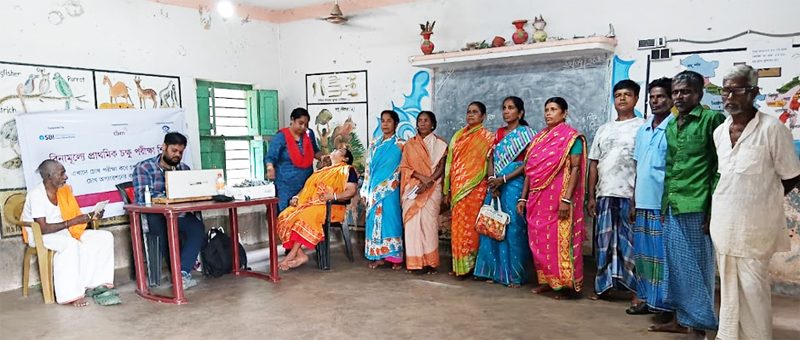
Patients requiring specialised care can be referred to Susrut's base hospitals for further evaluation and treatment.
A sustainable healthcare model should not only reach communities—it should also create opportunities within communities.
Susrut's Vision Centre approach creates a platform where trained local people can participate in delivering primary eye-care services and connecting communities to the larger healthcare system.
The organisation also describes trained local individuals conducting household screening using mobile applications and encouraging people with identified problems to visit their nearest Vision Centre.
Equip local people with relevant skills and knowledge.
Create opportunities to participate in community eye care.
Bring primary eye-care services closer to the population.
Link patients with Susrut's specialist network.
Develop a model capable of becoming locally sustainable.
One of the most powerful dimensions of Susrut's Vision Centre model is its potential to create self-entrepreneurship opportunities for women.
Women who receive appropriate training and become part of the community eye-care ecosystem can become more than healthcare workers.
They can become:
Bringing primary eye-care support closer to local communities.
Sharing awareness and encouraging healthier eye-care behaviour.
Building meaningful livelihood opportunities through healthcare.
Becoming trusted contributors within their own communities.
For a woman entrepreneur, a Vision Centre can become a platform for livelihood, professional development, leadership and meaningful community impact.
An opportunity to build a sustainable source of income.
A pathway to develop healthcare-related skills and experience.
A position of trust and responsibility within her community.
An opportunity to improve eye-health awareness and access around her.
A connection between underserved communities and Susrut's wider clinical network.
The Vision Centre network works alongside Susrut's wider outreach programmes, helping extend primary eye care, screening, awareness and referral services into communities.
Regular screening activities in rural parts of West Bengal.
Community eye-check-up camps for adults in urban and rural areas, including cataract identification and access to free or subsidised surgery for eligible elderly patients.
Screening through schools and ICDS centres for refractive errors and other eye conditions, with free spectacles where required and hospital referral for further treatment.
Specialised screening through community Vision Centres to identify diabetic retinopathy before it causes irreversible vision loss, with other conditions referred to the main hospital.
Taking primary eye-care services to remote communities through mobile services and technology-enabled delivery.
Training school and ICDS teachers on basic eye care, vision screening and referral, supported by community IEC activities.
Awareness is only the first step. Our goal is to help communities move from recognising a vision problem to knowing where to seek care and ultimately accessing eye care closer to home.
"I cannot see properly."
A person recognises that something may be wrong with their vision.
"I know where to go."
A Vision Centre provides a local point of access for primary eye care.
"I can access eye care close to home."
Local services make it easier to seek care, receive advice and enter the referral pathway.
Technology can help overcome one of the biggest barriers in rural healthcare: distance.
Susrut's Vision Centre model integrates information technology into community eye care, creating a connected pathway between local access and specialist expertise.
People seeking accessible eye care closer to where they live.
Primary eye-care assessment, screening and referral.
Specialist evaluation, treatment and connected follow-up when required.
A sustainable community-based eye-care model can create benefits that extend beyond clinical services, influencing health, livelihoods, awareness, participation and the wider healthcare system.
Earlier identification of eye problems and better access to primary eye care.
Opportunities for local employment and self-entrepreneurship.
Greater participation of women in skilled healthcare-related livelihoods and community leadership.
Greater awareness and improved health-seeking behaviour.
Healthcare becomes available closer to where people live.
A sustainable centre-based model can complement periodic camps and connect primary care with specialist services.
A connected model bringing together training, technology, local screening, awareness, referral, specialist care and community opportunity.
The local point of access for primary eye care.
Susrut's strength is not only its hospitals. It is the network that connects those hospitals to communities.
Every Vision Centre represents a closer point of access to primary eye care—and an opportunity to build a more sustainable, community-driven model of healthcare.
A Vision Centre succeeds when the community trusts it. That is why Susrut's model combines healthcare delivery with local participation, awareness, technology and connected referral pathways.
Healthcare works better when people understand it, participate in it and can access it close to home.
A woman-led Vision Centre can create a ripple effect that connects economic opportunity with healthcare access, awareness and stronger community participation.
We don't just want communities to see better. We want communities to become stronger.
The Vision Centre model creates opportunities for organisations, institutions, communities and individuals to contribute to a more accessible and sustainable eye-care ecosystem.
CSR-supported eye-care and community development initiatives.
Convergence with public health and community-health programmes.
Support for underserved communities and health equity.
Skill development and capacity building for community-based eye care.
Local mobilisation, awareness and community participation.
Supporting scalable community-based healthcare models.
Explore ways to support, strengthen or expand community-based eye care through the Susrut Vision Centre network.
A snapshot of the Vision Centre network and the wider community impact of Susrut's outreach model.
Districts covered
People screened
Children screened
Spectacles provided
Cataract surgeries supported
Door-to-door screenings
Women-led Vision Centres
People trained
Local entrepreneurs enabled
Data note: Annual screening, surgery, training and entrepreneurship figures should be updated using the latest verified organisational data before publication.
Every Vision Centre brings eye care closer. Every trained person creates a new opportunity. Every empowered woman strengthens her community. Every patient identified early has a better chance of receiving timely care.
Together, we can build a future where quality eye care is not determined by where someone lives—and where access to healthcare can also become a pathway to dignity, livelihood and empowerment.